Monday, December 30, 2013

Catholicism and the Literary Arts of Contemporary America

Dana Gioia has just published an excellent, indeed essential piece of commentary on the state of Catholic literature in the last sixty years or so, from the golden post-war period that culminated in the death of Flannery O'Connor in 1965, to the total impoverishment of contemporary Catholic literature. The secular forces have completely overrun the world of the fine arts to the point where being a Catholic is 'embarrassing', or even irrelevant to the rare artist who identifies as such. Meanwhile the Catholic hierarchy is more concerned with American party politics than the cultivation of art and culture, which has led to isolation on the part of what few Catholic writers there are, unable to promote their work via the structure of the Church.

This is an honest, powerful, and exceptionally well-written call to arms for any Catholic with artistic ambitions, and an evocative insight for anyone else even vaguely interested in a religiously-fuelled arts & culture. I have selected several notable portions for excerpts, but I strongly recommend reading the entirety of the article.


 The Catholic Writer Today


'Looking back on the mid-century era of O’Connor, Merton, Porter, and Tate, one could summarize the position of American Catholic literary culture with four characteristics. First, many important writers publicly identified themselves as faithful Catholics. Second, the cultural establishment accepted Catholicism as a possible and permissible artistic identity. Third, there was a dynamic and vital Catholic literary and intellectual tradition visibly at work in the culture. Fourth and finally, there was a critical and academic milieu that actively read, discussed, and supported the best Catholic writing. Today not one of those four observations remains true....


Today, if any living Catholic novelist or poet has a major reputation, that reputation has not been made by Catholic critics but by the secular literary world, often in spite of their religious identity. In literature, at least, the Catholic media no longer command sufficient cultural power to nominate or effectively support what is best from its own community. Has this situation disturbed Catholic leaders? Not especially. The Catholic subculture seems conspicuously uninterested in the arts.

What absorbs the Catholic intellectual media is politics, conducted mostly in secular terms—a dreary battle of right versus left for the soul of the American Church. If the soul of Roman Catholicism is to be found in partisan politics, then it’s probably time to shutter up the chapel. If the universal Church isn’t capacious enough to contain a breadth of political opinion, then the faith has shriveled into something unrecognizably paltry. If Catholic Christianity does not offer a vision of existence that transcends the election cycle, if our redemption is social and our resurrection economic, then it’s time to render everything up to Caesar....


The schism between Christianity and the arts has had two profound consequences, two vast impoverishments—one for the arts world, the other for the Church. First, for the arts world, the loss of a transcendent religious vision, a refined and rigorous sense of the sacred, the breaking and discarding of two thousand years of Christian mythos, symbolism, and tradition has left contemporary American art spiritually diminished. The shallow novelty, the low-cost nihilism, and the vague and sentimental spiritual pretensions of so much contemporary art—in every medium—are the legacy of this schism, as well as the cynicism that pervades the arts world.... The voice of religious faith enlarges and enlivens the overall dialectic of culture, even among non-believers, just as the voice of secular society keeps religious writers more alert and intelligent. Once you remove the religious as one of the possible modes of art, once you separate culture from the long-established traditions and disciplines of spirituality, you don’t remove the spiritual hungers of either artists or audience. You satisfy them more crudely with the vague, the pretentious, and the sentimental. The collapse of the culture that supported O’Connor and Porter, Powers and Merton, led to the culture that consumes teen paranormal romances, ghost reality shows, and internet Wiccans.....


The loss of the aesthetic sensibility in the Church has weakened its ability to make its call heard in the world. Dante and Hopkins, Mozart and Palestrina, Michelangelo and El Greco, Bramante and Gaudi, have brought more souls to God than all the preachers of Texas. The loss of great music, painting, architecture, poetry, sculpture, fiction, and theater has limited the ways in which the Church speaks to people both within and beyond the faith.

Catholicism rightly revels in its theological and philosophical prowess, which is rooted in two millennia of practice and mastery. Theology is important, but formal analytical thought—the splendeur et misère of Roman Catholicism—is not the primary means by which most people experience, accept, or reject a religious faith. They experience the mysteries of faith (or fail to) in the fullness of their humanity—through their emotions, imagination, and senses as well as their intellect. Until recently, a great strength of Catholicism had been its glorious physicality, its ability to convey its truths as incarnate. The faith was not merely explained in its doctrine but reflected in sacred art, music, architecture, and the poetry of liturgy. Even St. Thomas Aquinas knew there were occasions to put theology aside and write poetry. His resplendent verses are still sung with incense at Eucharistic Benediction. “Bells and incense!” scoffs the Puritan, but God gave people ears and noses. Are those organs of perception too humble to bring into church? For very good reason, participating in Mass involves all five senses. We necessarily bring the whole of our hairy and heavy humanity to worship....


The Catholic writer understands the necessary relationship between truth and beauty, which is not mere social convention or cultural accident but an essential form of human know­ledge—intuitive, holistic, and experiential. Art is a form of knowing—distinct and legitimate—rooted in feeling and delight—that discovers, in the words of Jacques Maritain, “the splendor of the secrets of being radiating into intelligence.” That insight makes possible the great potential of Christian literature to depict the material world, the physical world of the senses, while also revealing behind it another invisible and eternal dimension....


The renewal of Catholic literature will happen—or fail to happen—through the efforts of writers. Culture is not an intellectual abstraction. It is human energy expressed through creativity, conversation, and community. Culture relies on individual creativity to foster consciousness, which then becomes expanded and refined through critical conversation. Those exchanges, in turn, support a community of shared values. The necessary work of writers matters very little unless it is recognized and supported by a community of critics, educators, journalists, and readers. The communion of saints is not only a theological concept, it is the model for a vibrant Catholic literary culture. There is so much Catholic literary talent—creative, critical, and scholarly—but most of it seems scattered and isolated. It lacks a vital sense of cultural community—specifically, a conviction that together these individuals can achieve meaningful change in the world. If Catholic literati can recapture a sense of shared mission, the results would enlarge and transform literary culture.

If the state of contemporary Catholic literary culture can best be conveyed by the image of a crumbling, old immigrant neighborhood, then let me suggest that it is time for Catholic writers and intellectuals to leave the homogenous, characterless suburbs of the imagination and move back to the big city—where we can renovate these remarkable districts that have such grace and personality, such strength and tradition. It is time to renovate and reoccupy our own tradition. Starting the renovation may seem like a daunting task. But as soon as one place is rebuilt, someone else will already be at work next door, and gradually the whole city begins to reshape itself around you. Renovation is hard work, but what a small price to pay to have the right home.


Maecenas Presenting the Liberal Arts to Emperor Augustus, Giovanni Tiepolo, 1743


Wednesday, November 27, 2013

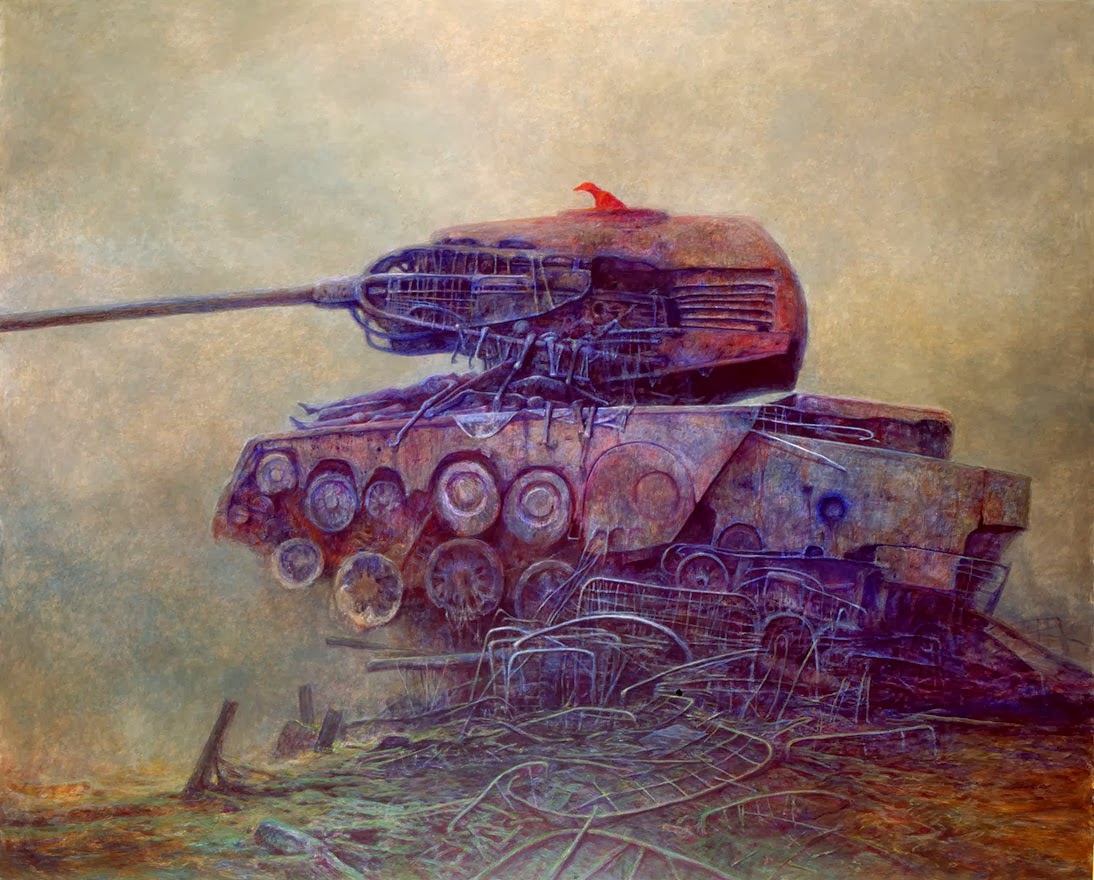
Zdzislaw Beksinski and the Silent Rebellion


In 1929, Zdzislaw Beksinski was born in the Carpathian town of Sanok in the southeast of Poland. He would therefore spend the later part of his formative years in a Poland divided by war and the Molotov-Ribbentrop Pact, an oppressive atmosphere that inevitably influenced the artist and his work further on. While he would eventually become known primarily for his painting and his photographic material, Beksinski was initiated into the arts by studying architecture at the University of Krakow in his early twenties; those studies only enabled him to become a construction site supervisor, however, a position that he was discontent with, considering its pressures and the associated boredom. As it often happens when any innately skilled artist is being wasted on things alien to his nature, Beksinski left the job and devoted himself at first to photography and sketching before finding his full potential in painting, the result of which shall be the main subject of what follows. Beksinski suffered a dramatic end to his life when he was murdered by a young associate (the son of his caretaker) to whom he had earlier refused a loan.

'It misses the point to ask me what scenes in my paintings “mean”. Simply, I do not know, myself. Moreover, I am not at all interested in knowing.'

One thing that should be noted from the start is that, as the quote above indicates, Beksinski was vehemently against any single interpretation of his work; in this, he is strongly representative of the 20th Century, which struggled with the emergence of pure subjectivity in art criticism, and the idea that art did not need meaning or formal structure. The fact that Beksinski was not aware of the meaning in his art does not necessarily corroborate the analysis that his works do not contain strong meaning; it is clear that art, especially in the past couple of centuries since the Romanticist era, frequently acts independently of its creator's ideas or conscious intentions. The work says something more than, or sometimes even antithetical to, what the artist himself says. So, Beksinski telling us that there is no reason to ask him for meaning, for the key to his cryptic artwork, is no reason to say that there is no meaning; simply because Beksinski was uninterested does not mean that we have to be uninterested.

The art of Zdzislaw Beksinski so consistently takes on the thematic form of an apocalyptic or post-apocalyptic world because the past hundred years or so, in the wake of art theorist Jose Ortega y Gasset and other radical proponents of modern art and the subsequent dominance of 'post-modernism', has symbolically been a sort of 'apocalypse'; the collapse of meaning and form in art has spawned an infinite variety of different scenes and trends and interpretations that simultaneously assault any conceptual unity that might have prevailed as in previous centuries. Whereas movements like Baroque and Romanticism took several decades and sometimes even centuries to exhaust themselves, the freneticism of the modern mind, the rapid progress of technology and new avenues of artistry, and the ever swifter vagaries of fashion have conspired to invoke a new, different angle and then make it obsolete in about the lifetime of the average automobile. It is a constant oscillation, a steady rise of new and sometimes simultaneous reactions to whatever came before, and this is precisely what the art of Beksinski is concerned with, namely, the creation of a style that is both modern and timeless, a style that both forebodes the end of the present and prophecises the birth of the future. It is said that, despite the bleak subject matter and invariably dark hues, his work is inherently optimistic - and so it is, for what could be more optimistic than the annihilation of a disingenuous and chaotic and totalitarian generation; more optimistic than the hint of the rebirth of an art once again informed by conscious direction and sacred content?


This rhetoric is met nowhere more completely than in Beksinski's 1977 painting, which, in the absence of his own title for it (he never titled his paintings), we will simply call Rider of Rebirth. This work is one of his most obviously apocalyptic works firstly in its dark colours of black and red that contrast agreeably with the pale grey that represents death of the skeletal horse and its (presumably) female rider, and secondly the potent symbolism of the horse and rider, which recalls the Apocalypse of St. John, in which he visualizes the four horsemen of the Last Judgment. The red and orange that constitute the background in Rider of Rebirth imbues the viewer with the knowledge of destruction, of fiery devastation and ruin, while the paleness and the anatomical desolation of both horse and rider suggests the purity and the finality of death. The fact that the woman's deeply black hair obscures her face implies her inhumanity, her frail anonymity. The fact that the small person she is holding is of a bluer, clearer quality is significant in that he is not of the same substance as that which bears or holds him – he is something distinct from the surrounding chaos as well as the deathly things, which, along with his possessing the appearance of a child, could assert that his nature is innocent of whatever afflicts his environment, and that he is the seed or symbol of something that lives on when all the rest passes away.

The life work of Zdzislaw Beksinski belongs firmly to the canon of modern art insofar as it is a reaction to the thesis of modern art, which asks us to eschew the 'burden' of determining objective significance and to delight in the joys that the art brings to us personally, however we might interpret it. We will not say that it is an outright rejection of that thesis, especially considering the fact that Beksinski had no interest in understanding the formal content of his art, but the subject matter and seeming unconscious efforts on the part of the artist transparently reveal the ongoing degeneration of the past century and the present one on several levels, so his work, like much of modern art in whatever aspect (plastic or literary, theatrical or musical), is the implicit manifestation of the European spirit in reaction to what currently occupies it. This is why much (though not all) of what is best in our era comes across like a story from Poe or Lovecraft: from the music of Black Sabbath and Tangerine Dream to the films of Lars von Trier to the paintings of H.R. Giger and Zdzislaw Beksinski, real contemporary art represents the Promethean struggle of the unconscious 'Faustian' soul to fight off the shackles of post-modern individualism and broad social discord, and phoenix-like to perhaps plant the seed for rebirth in its death.


Tuesday, September 24, 2013

Notes on Noctis

FRIDAY, September 20th


PAGAN ALTAR


Before going into this festival, the sixth and allegedly final Noctis, I figured that with the likes of Revenge and Blasphemy headlining Friday, there was going to be no chance that Saturday could possibly rival it. While my figuring turned out to be right in the end, it was not so much the RBC legions that set the bar so impossibly high, but the two prior bands who dominate my remembering as they dominated wide swathes of the audience that night.

Pagan Altar were simply my favourite act of the entire weekend. From the perfect balance of pompous showman and serious storyteller exuded by old man Terry Jones to the impeccably medieval atmosphere emanating from their highly distinct musical personality, Pagan Altar actualized and ritualized a moment of mythic grandeur with forcefully theatrical convictions. Approaching the Epic as nearly as can be expected from any metal band, Pagan Altar were demonstrably unique (Jones' vocals are certainly 'love or hate'), musically incisive and clear, and positively apocalyptic in their overall dynamic; when Jones was wailing ominously during 'The Black Mass', 'This is the age, the age of Satan', I was inwardly confident that he was actually heralding a new era, the rise of Antichrist or some other malignant beastie.

As things stand, the Pagan Altar vocalist was merely announcing the commencement (for me at least) of Noctis 666, historically Canada's finest music event West of Quebec. On a more personal note, Pagan Altar were particularly memorable in that, after they were done, this other patron gave me one of Deano's drumsticks he had cast into the crowd, saying that, given my rambunctious singing along and the obvious physical enthusiasm I had shown during their set, I clearly liked Pagan Altar more than he did, and therefore merited the memoir.

GORGUTS 


Seeing as I had already witnessed the Gorguts live performance at a previous festival, I had no right to be surprised by how good, how absurdly powerful their show is - but I was, I was blown away for a second time by a band that I honestly hardly ever listen to. The general rule with the more technically inclined bands is that their concert often suffers for it, with the players almost exclusively devoted to higher levels of concentration. This is not the case with Gorguts, who recruit that intense focus and elaborate, articulate instrumentation into a collective power that is altogether simple in its singular, direct assault. The music immediately comes across as at once frenzied, brutal, disorderly, and anarchic, but it is the firm structure underlying the swarming turbulence that provides the violence with that necessary law & order; metaphorically speaking, the infinite pieces of this universe seem to be governed by deranged demagogues, subsisting in a vacuum of meaning, but in reality it is either eventually normalized into patterns and persists in aeternum or it perishes altogether. That is Gorguts.

Despite being cut short due to unfortunate time constraints, this was truly a phenomenal show, an admonishing reminder of the strength of these French-Canadian stalwarts that I should not have needed nor will need again.


REVENGE


Compared to the precise and pristine clarity of the previous act, Revenge sounded like the interior of a Kriegsmarine U-boat being bombarded by the depth charges of an hunting destroyer. And that is exactly what a Revenge ritual is, really, the motivated reconstruction of the modern battlefield; the explosive weaponry, the shattered husk of humanity are retrieved visually and aurally through the demonically-inspired percussion of James Read, wreathed in smoke, and his two attacking minions in the vanguard. While I would have loved seeing Revenge with Pete Helmkamp still at the helm, they have actually done their best work following his departure, and the new songs they performed must have improved their live set considerably, giving it more balance and individuality after the rather formulaic albums following Triumph.Genocide.Antichrist. There were complaints voiced toward the sound guys, that Revenge were not loud enough, but that was immaterial for me; the music itself is comprised of an inherent loudness that mastered the room. They also covered 'Equimanthorn', which was a lovely touch.

BLASPHEMY

Making their faithful following travel hundreds of kilometres to an overgrown prairie town when they should be playing Vancouver at least once every two or three years, Blasphemy bore the brunt of the Friday night's collective expectations (even if there seemed to be many cowards leaving after Gorguts). I later realized that perhaps the sound guys were smarter than we gave them credit for, lowering Revenge's sound in order to build up more effectively to the Blasphemy colossus. In any case, Revenge proved to be the perfect foreplay to the climactic release of the main event, the more 'limbre', percussively-oriented descendant tonally setting the stage for their behemoth forebears to complete the devastation.

While their being old and a bit heavier now prohibits them from athletic amounts of onstage movement (I think Caller of Storms might have nodded a couple of times), the prevailing aura is as vibrant and virile as ever. The audience was witness to a monumental demonstration of compelling chaos; primordial energies were bound up and unleashed, tempestuous tyrants of primal sound were lords of the night. The chaotic element was not organized and sublimated into a coherent unit like an Arctic trainer might master his impetuous pups into disciplined sled-dogs; the chaos that Blasphemy 'organized' was loosely gathered and then conveyed in a vague, general direction, rather like the warlords of old would goad their war elephants into battle, hoping that they might trample about and do more damage to the enemy than their own troops. This is the distinct, lasting impression that Blasphemy made on me that night, the image of an inexorable, semi-armoured monster of an animal gone berzerk in the wildness of war.

Finally, there was a more mundane feud ongoing between Blasphemy and the powers that be over the curfew the University imposed on (presumably) any concert; they were not allowed to play beyond midnight, meaning they were forced to cut out their intros and outros, and at least a couple other tracks.  Being irresponsibly drunk by this point, I was unconcerned, and simply elated by the reality that I finally got to experience BLASPHEMY.


SATURDAY, September 21st


SACRIFICE

Again skipping the first few bands (would not have minded seeing Witch Mountain though), we arrived in time to see one of the elite thrash metal bands from the eighties, who just happened to fulfil two of the major themes of this year's Noctis: being old and Canadian. Sacrifice played a fluent set, unveiling a thick volume of coarse, riveting riffs that carried them forward. Every song was constructed around these propulsive guitar lines; the newer songs, too, fit in seamlessly with their classics, such as 'Re-Animation', which thoroughly blitzed the crowd at the show's conclusion. The lead guitarist and the drummer seemed exceedingly happy to be there – the latter in particular wore a stupid grin for virtually their entire forty minutes. Full credit to them.


POSSESSED

The first time that I saw Possessed live left me fairly disappointed due to a mistaken bias that I see no need to repeat here (inside joke, you get it or you don't). Being relieved of this error, I was all ready to enjoy Possessed like it was my first time seeing them, and I was rewarded for it. Selecting heavily from Seven Churches, their magnum opus and a cornerstone of all death metal, Possessed were absolutely crushing, delivering all of the potent and molten madness that they are known for in the space of less than an hour. I remarked to my friend that I never truly saw Slayer play since my only time seeing them was in the cavernous BC Place, and not in even the most remotely intimate venue. Well, experiencing Possessed play songs like 'The Exorcist', 'Fallen Angel', and 'Death Metal' is most likely the next best thing considering the strong link between Possessed and early Slayer, a link that was only reinforced by the screaming intensity with which Possessed performed their material. The fact that the vocalist (who was also grinning stupidly the whole time) was clearly hammered only added to the concert's overall joviality; every one we spoke to thereafter was delighted and pleasantly surprised by Possessed.


CANDLEMASS

As Girlschool were up next, I doubled my beer order and waited them out (if I received a loonie every time someone mentioned 'like Motorhead played by women' I wouldn't have had to pay for this trip). Certainly the band that I was looking forward to the most on Saturday, Candlemass professed an air of class and confidence from the start; similar to the previous day's Pagan Altar, Candlemass achieved an atmosphere that expressed an ancient attitude, a Gothic recreation of oral storytelling. Utilizing much of their old catalogue for their setlist, we got to experience beautiful renditions of songs like 'Under The Oak', 'Solitude', and 'At the Gallows End' conveyed with the same kind of charm and aged sagacity that we praised Pagan Altar for; where Candlemass differentiated themselves was in their more sombre, more refined tonal approach and in their more serious aesthetic, lyrical dimensions. The same general idea of an old man telling an epic story was there; the difference resided in that Candlemass had a moral to that story, a resonant message that was more thought-provoking and pathetic, while Pagan Altar were quite content being the harbingers of doom, regardless of good or evil.

Ousting the previous vocalist Robert Lowe for an insufficiently charismatic live presence, Candlemass have more than solved that in (again) recruiting experienced journeyman Mats Leven, a natural leader who was persuasively engaging, and whose vocals were unfailingly dominant, up to the high standard set by the singing on any Candlemass album; he even did a bit of the Messiah stomp during 'Bewitched', delighting the crowd thereby. The music was tight, clearly expressed, and again evocative of a medieval perspective, Leven's semi-operatic, exaggerated intonations combining with the profoundly melodic and visceral guitar lines to enforce a distinctly dramatic presentation, like a troupe of tragic actors performing at a high European castle. That I saw bassist Leif Edling sipping at a glass of red wine only enhances my conviction that Candlemass are indeed the most Catholic band in metal.

CARCASS

Although Carcass were inarguably the chief draw for the majority of patrons at the event, they were honestly the least of the eight bands reviewed here that I was looking forward to. Still, they played a good set, though expectantly far too reliant on the post-Necroticism portions of their discography. The frontman Jeff Walker established a good rapport with the audience, telling jokes and generally cutting an amusing figure as he went through some decent stage banter. 'Corporeal Jigsaw Quandary' was undoubtedly the highlight of the Carcass act, for both myself and the audience if their explosive reaction to the first notes are anything to go by. It looked like they also had to cut out at least one track due to that curfew again, because, you know, students living in dormitories have to go to bed at a reasonable hour on Saturday nights.


FINAL NOTES


Because I like lists & clarity here is a ranking of how I deem the weekend's performers overall

1. Pagan Altar
2. Candlemass
3. Blasphemy
4. Gorguts
5. Revenge
6. Possessed
7. Sacrifice
8. Carcass


One thing that once again impresses me about the metal community is how there are no rigid divides between artist and fan, no barrier that separates us like the one that develops when a musical icon attains celebrity status. At this level, everyone there is a fellow supporter, regardless of whether he plays the leading role for the headlining band the next night or not; we could hang out with members of the bands without too much nervousness on one end or hubris on the other; my friend could spill her breakfast on Blasphemy's Caller of Storms and not have to worry about security swarming her or a viral youtube video; we could fraternally witness Terry Jones from Pagan Altar confusing himself over our magical Canadian maple syrup, figuring it to be some kind of HP sauce like any Englishman would. At this level, there are no untouchable celebrities, just fellow fans of the music and potential friends.

On the other hand, however, I was reminded of all the deficiencies I perceive in the metal community, particularly after Saturday's festivities were finished, and I was exhausted in every possible way by the degradation I had immersed myself in. From guys sprawled out on the bathroom floor trying to puke to the vomit itself reeking the train back to Calgary proper, in addition to the general lack of hygiene and good taste (somebody asked me how much my haircut cost, which must be a kind of insult because it made even less sense as a compliment considering the long-haired greaser who asked me), I was physically revolted, and reminded of the filthy crusties who went around the venue drinking the last drops from the empty beer cans littered everywhere. Then there was the social activist for global Satanism who hurled a burning Bible from his hotel room onto the pool deck where we were gathered (some were swimming) at ~4 AM. I suppose that it was for these reasons and my general state of exhaustion and post-drunkenness that led Chris ('Vermin') from Revenge to say to me, 'you look like you're saying to yourself, “I hate every one of these fuckers”.' It is more than slightly frightening that a longstanding member of one of the most misanthropic musical genres around can say that about me, but I daresay that in that moment he was more right than not.

Anyway, I was there for the music, and that was more than rewarding in itself. A real shame that this could very well be the final Noctis, as Vancouver is starved enough as it is for quality live music, and now we are being deprived of one our our key semi-local outlets for incoming bands of the kind of heavy calibre that we were privy to on this gloriously dark weekend. But it was certainly good while it lasted, and in the future may these quick notes prove to be strong enough to incite positive images where my memory fails.


Monday, August 19, 2013

Orpheus & Christ


This was the most impressive, the most stirring of the poems found in Boethius' Consolation of Philosophy... In this, the legend of Orpheus who descends into Hades to save his Eurydice from death, we recall also the adventures of Hermod as he strives to rescue Baldr, beloved of the gods, and how he is equally unsuccessful, coming as close to saving Baldr as Orpheus was to saving his wife.

Moreover, we bring to mind that it was only Christ who truly succeeded in His trip to Hell, rescuing not merely an individual, but effecting the nominal salvation of all souls for all eternity. Herein lies an exemplary truth of the Christian religion, namely that it really is the salvific force that has redeemed everything prior, and has made new meanings from already rich traditions of myth & symbol. Eurydice and Baldr were not saved by their pagan heroes - they were saved by Christ, the destroyer of death & the fountain of eternal life.

Anyway, Boethius was a philosopher who represented as much as any other the meeting point between the Classical world and the Christian, as well as someone who offered a masterly synthesis of Aristotle & Plato that proved to be a model for high scholasticism. This poem is beautiful in its simplicity, its moving pathos, its illustrious imagery, its philosophic sweetness, but it is particularly notable for its subtle hints at the inner compatibility of our pagan past with Christian omnipresence; the love of Orpheus for Eurydice is undoubtedly potent, and indeed a law unto itself, but the love of Christ is something even more substantial... It is at once the love that binds and the love that frees us from any other law.


Happy, the one who can see
the clear source of good,
happy, the one who can release
the chains of heavy earth.
Once the prophet of Thrace
mourning his dead wife
when with tearful music
he compelled nimble forests to run,
the rivers to stand
and deer joined unafraid
beside the fierce lions
and the rabbit did not fear the sight
of the dog already calm from the song,
when hotter inside
the fervor of feeling burned
and the measures of the one who had subdued all
could not soothe the master,
lamenting the inexorable gods above
he went to the lower worlds.

There by sounding strings
moderating charming tunes
whichever he drew
from the special source of the mother goddess,
which powerless lamentation was giving,
which love bewailing lamentation
the lower world moving weeps
and by a sweet prayer asks
the lords of the ghosts for indulgence.

The threefold porter is astonished
captured by the new song;
the avenging goddesses of crimes
who drive the guilty by fear
next are drenched by tears of grief;
the head of Ixion is not
thrown down by the fast wheel,
and ruined by long thirst
Tantalus spurns the streams;
now the vulture is sated by the music
and does not pull at the liver of Tityos.

Finally 'We are conquered'
the pitying witness of the ghosts declares.
'We bestow on the man the accompanying
wife bought by a song;
but a law controls the gift,
until she has left the underworld
to turn the eyes would not be allowed.'

Who would give a law to lovers?
A greater law is love to itself.
Alas, near the boundary of night
Orpheus upon his Eurydice
looked, lost, fell.

This fable looks back to you
whoever of you into the day above
seeks to lead the mind;
for the one who in the chasm of the underworld
having been conquered has turned the eyes,
whatever special one carries off
one loses when one sees the lower worlds.


Thursday, May 23, 2013

A Special Point of View; or, Why I Am an Optimist


There are exactly two ways of viewing the world: we either understand that it is something good, or something evil. The perspective of any man derives from his understanding of what the world really is. This is why there is no such thing as a ‘realist’; reality, in the sense that those who call themselves ‘realists’ use the term, is the objective universe, something that we experience individually through our own subjective understanding. To put the matter more clearly, as Francis Parker Yockey says, ‘Pessimism only describes an attitude, and not facts, and hence is entirely subjective’. Pessimism and optimism are adopted attitudes by which we view the world, but realism is not a viable third option, since reality is the subject matter, and can never be the subject.

We are human, which means that we cannot possibly experience reality in a purely objective state; we are not machines, which are programmed to go about their business utterly unconcerned about whether ketchup tastes good, or why the sky is blue, or how full the glass of water seems to be. The calculator knows which numbers will appear on the screen, and cares not one whit; the car dealer has a rough idea of what those digits will be, yet wishes them to be higher. We are human, which means that we cannot help but be partial to reality, whether it be the girl we choose to marry or what we will have for lunch. Reality is conditioned or filtered by the nature of the subject, and is thereby experienced uniquely by the subject. Every one of us is a world unto himself, and there is not one world that is identical to any other. There is no such thing as a realist because we are all realists.

There is, however, a greater world that prevails beyond our own subjective spheres – it is this which we can more truly call ‘reality’, and it is this which we can deem either good or evil. From the position of the philosopher, pessimism is the mental mood or moodiness wherein we consider reality fundamentally flawed, randomly arranged and pointless, existentially void, entirely ordered by malignant forces, et cetera; it is the philosophy responsible for Schopenhauer’s fatal maxim, ‘human life must be some kind of mistake’; it
is the philosophy fashioned by millennia of looking into the ice and not seeing the water below, but merely the twisted grimace of one’s own face. If human life is a mistake it must be the fault of the human. If our existence is boring or pointless it is because our soul has grown hard like stale bread, the imaginative lifesblood has dried up; it is because we have been scribbling furiously at the Songs of Experience, but have quite forgotten to sing the Songs of Innocence. Pessimism is therefore the state of mind that has suffered the shock of pain and concludes that pain alone comprises the fabric of reality; it is not the brave duel of man with the futility of life but merely the mediocre despair that gives way before both health and disease, before both the daily tedium and those rarer moments of ineffable joy. Pessimism is cowardice.

The idea that this place we inhabit is somehow insufficient or insufferable is an extraordinary insult to its Creator; pessimism betrays an ungracious pride that speaks either of a dreadful ignorance of what is good, or of an infantile petulance that wails continually for something better, something more. Pessimists typically like to think that they are simply the ones who are strong enough to be able to look at the facts right in the face, and maintain no illusions about the ‘cold, hard truth’. It is rather that they do not know anything about the truth, which is why they become pessimists. The truth is that behind every seemingly chaotic event there is a causal order; the truth is that behind every act of evil there is the potential for recovery and redemption, and a deep potential for saintliness that exceeds all manner of spiritual crime. As Job came to learn the hard way, as he knew more than anyone else, God did not create this earth for our suffering alone – He created this earth so that our suffering might mean something, and that it might also mirror the joy of the heavens on those special occasions when we have the strength to see it.

Now, the trickier part of this essay will be to distinguish between the blind, or false, brand of optimism, and the true, or visionary, optimism. The false form of optimism appears in the guise of the pantheist, the evolutionary thinkers, the progressives, all the men and women who believe without question in the popular creed that our civilization, our entire species is moving in an inexorably positive direction; science, technology, discovery, medicine, social tolerance are all profound pieces of evidence which these beaming prophets readily supply to secure this claim, saying all the while, ‘look how advanced, we can count the stars whereas before we could not count the dead of the Inquisition’, or, ‘look how healthy, we can live forever whereas we could formerly hardly make it to age fifty’. The most common substance that ties these claims together is clearly that of quantity over quality. Our world is more and more of this and that, but we will never hear the blind optimist admit how our world is less, not so much in degree, but in kind.

Allied as it is with secular humanism, this species of optimism is bound up with a fervent denial of God. The false optimist believes quite simply that the world is unconditionally and unreservedly good because he has made it the substitute for the divine. It is man that directs progress, and it is Nature that provides the material; the world is capable of being dissected and classified, organized into scientific laws that document and regulate reality because that is all that there is to reality. So, unlike the old pantheists and pagan merry-makers who had the excellent excuses of a youthful jubilance and an intrepid imagination that coloured their world with every type of dancing deity, contemporary optimists believe in a world relieved of its metaphorical visage, its mythical veil. The god of the blind optimist is a naked brute, for that is all that
Nature is when she is stripped of her clothing and paraded through the streets – without the voice of the poets and the warmth of imagination, Nature is a brute.

The truth is that not everything is good. There are a great many things that are not good, but evil. The truth is that our civilization is not currently strapped to the rocks, equipped with an ice axe, ascending with the slow and steady movement of the skilled climber; far from the dreams of progressives, we are rather tumbling down the mountainside head over heels, oblivious to the means by which we might save ourselves, or at least slow our crazed descent. The physical universe is a wildly beautiful dimension; but it is not the only dimension, even if that is what we think our scientific instruments are telling us. It is furthermore a cruel and wicked dimension a lot of the time – if there truly is no God, then the ‘problem of evil’ is thrusted upon the shoulders of the false optimist, and we fear that he is not quite as well-prepared to bear it. In both cases, whether he believes in the absolute good of human evolution or more broadly in the self-sufficient good on the material world, the optimist is invariably unable to truly answer why he believes in these things. We might very well hear him bluster on about how far we have come since the ‘evils of Patriarchy’, or how the world is sufficiently beautiful without the adornment of fictional figures like Hermes and Morrigan; but ask him why women are qualified to operate in business or in the mines when they are not qualified to be the mothers to their own children; ask him how magical the universe becomes when you stop seeing Apollo in the dawn of every amour, and Daphne in every rejection. Ask these positive people why they are so resolutely positive in their flickering creeds and you will only hear the same tired clichés, the sentimental axioms that the explorer tells himself when he is lost but thinks he is nearly there; you will hear something like, ‘it is just around the corner, everlasting peace, we are on the right road, if only we could find the missing link, perhaps around this corner’. Optimism is also cowardice, for it is the refusal to admit that not everything is good, that we are not indeed near the top but are still sliding down the mountainside – the tragedy is that only the bottom will smash our illusions, as well as our back.


Between, or rather against both of these perspectives, there is what we have called the ‘visionary optimism’, or what G.K. Chesterton has called the ‘Christian optimism’. The world is essentially good, but that is because it is firstly the creation of a divine artist, which the false optimist dismisses altogether; once we deny the Creator we deny creation. The world is essentially good, but that is because it is accidentally evil. What we mean by this is that the universe exists as part of an overflowing abundance of love and creativity deriving from the eternal being of God, and this great good has entered the void, and, ex nihilo, a world appears. In order for this place to have any existence of its own, that is, an existence distinct from God Himself, it must be at least partially outside of God – and that is whence evil comes, from the nothingness outside of God. The universe is a battleground for the fullness of God’s being against the nihilism of the abyss. The world is at once good and evil: good inasmuch as anything that exists is an emanation of divine being, and evil inasmuch as anything that is not wholly good or real is an emanation of non-being. All life represents the struggle towards wholeness in the hopes of escaping the infernal forces which seek to separate and divine, to make unreal. The pessimist sees the world as evil manifest, tending emphatically towards the void, whereas the false optimists thinks of us as sufficiently good and real in ourselves, and that we are not in any need of salvation; the truth is that we are in need of salvation because we are responsible for the evil.


‘Men did not love Rome because she was great. She was great because they had loved her.’ ~G.K. Chesterton


The above aphorism illustrates the fundamental point of our optimism, which is simply to love and celebrate something that is ours, like we love our sons unconditionally, even if we might not like them, even if they grow up to be something utterly distasteful. We are the human stewards of a vicious, generous, turbulent, colourful, random, beautiful, deadly world; its nature is equally enthusiastic towards helping us with bountiful harvests as it is towards hindering us with hurricanes and blizzards. We are the stewards responsible for the senseless murder of our own kind, the avaricious rape of the environment for the sake of industry, the vast array of deviant crimes and perversions that result from our fallen nature; the world is good, but it is not unconditionally good, which is why we can never worship 'mother earth', but love her as we would a sister, or our native country, to borrow two more Chesterton similes.


‘My acceptance of the universe is not optimism, it is more like patriotism. It is a matter of primary loyalty. The world is not a lodging-house at Brighton, which we are to leave because it is miserable. It is the fortress of our family, with the flag flying on the turret, and the more miserable it is the less we should leave it. The point is not that this world is too sad to love or too glad not to love; the point is that when you do love a thing, its gladness is a reason for loving it, and its sadness a reason for loving it more.’ ~G.K. Chesterton


While Chesterton calls this attitude ‘cosmic patriotism’, it is clear that it is really the richest, most radical optimism. We love the world because it is our world, because it is the source of every morning’s joy as it is the source of every evening’s tragedy; we learn to walk and to talk, and we learn that we must die, and that our loved ones must die. We love God because He is good, but we do not love the world because
it is good, nor do we hate it because of how it causes grief and suffering; we love the world because it is good but tinged with evil, because it is life refreshed by death. This optimistic exuberance means that we can never cease loving the world, since we see beyond both how ‘good’ or evil it seems to be, and simply love it for what it truly is, which is the flawed but wholly honest creation made by God and the creatures who keep it going.


‘The world is indeed full of peril and in it there are many dark places. But still there is much that is fair. And though in all lands, love is now mingled with grief, it still grows, perhaps, the greater.’ ~J.R.R. Tolkien


Optimism is indeed the attitude which is rightly paralleled with the virtues of hope and heroism; it is not necessarily the perspective that looks merely at what will happen if everything goes right, but it is the perspective necessary for carrying on the fight with the same joyous heart that we enjoyed from the beginning of the fight, even if everything has gone wrong. Our optimism is alive so long as hope is alive, and the activity resulting from our hopeful optimism is called heroism. To act with the knowledge that all is lost is honourable; to act with the same knowledge but with a happy heart, armed with the superior wisdom that what we do is but a glimpse of heaven’s paradox, is heroic. Gandalf says that the hope to destroy the Ring and to save the civilized world was ‘just a fool’s hope’- but is there anything that is really foolish about hope? On the surface, of course there is; who could fail to laugh at anyone who seriously believed that Liverpool would go on to win the 2005 Champions League final at half-time, when they were losing 3-0 to a seemingly invincible
A.C. Milan side? But, so long as we are not blind to the consequences like the false optimist, with his stubborn insistence that an unwavering scientific authority and socialistic programs are all well and good for the progress of civilization, there is absolutely no harm in such a belief, in such a resilient hope, and yet look at the rewards! Liverpool went on to lift the coveted trophy, the combined might of the West stalled Sauron’s forces, and between Frodo, Samwise, and Gollum, the Ring was consumed by the fires of Mt. Doom. Optimism is the underlying perspective that allows the slightest hint of hope to become possibility, and it is the perspective that allows heroism to make that hope become reality.

So, in opposition to both the defeated pessimist and the blind optimist, the visionary optimist is keenly aware of the fallen nature of our world, the infinite potential for evil that man has in store, and yet maintains his paradoxical faith in the overarching goodness in man and in reality as we know it; the visionary optimist proudly brandishes his foolish hope that good will always conquer evil, even when it does not. The essence of the matter is ultimately a matter of will, a matter of choice: we can choose to be sour old men and passively await the cataclysm with the smug consolation of being able to say ‘I told you so’ at the last; or we can be juvenile idealists who relentlessly hammer into the heads of all who would listen the notion that everything is quite fine without bothering to look above, to see the gathering of the storm; or we can choose to recognize the imminent danger, to recognize the fact that most of our comrades are deaf and dumb or otherwise useless, and yet lead them all into a silly song as one final moment of human defiance to the cruelty of the cosmos. Optimism really is the force responsible for making the best out of every situation; optimism really is the perennial pursuit of the best in the face of the worst.


Now the final thoughts from G.K. Chesterton, someone who is infinitely more qualified to argue for our subject.

‘…all the optimism of the age had been false and disheartening for this reason, that it had always been trying to prove that we fit in to the world. The Christian optimism is based on the fact that we do not fit in to the world. I had tried to be happy by telling myself that man is an animal, like any other which sought its meat from God. But now I really was happy, for I had learnt that man is a monstrosity. I had been right in feeling all things as odd, for I myself was at once worse and better than all things. The optimist's pleasure was prosaic, for it dwelt on the naturalness of everything; the Christian pleasure was poetic, for it dwelt on the unnaturalness of everything in the light of the supernatural. The modern philosopher had told me again and again that I was in the right place, and I had still felt depressed even in acquiescence. But I had heard that I was in the wrong place, and my soul sang for joy, like a bird in spring. The knowledge found out and illuminated forgotten chambers in the dark house of infancy. I knew now why grass had always seemed to me as queer as the green beard of a giant, and why I could feel homesick at home.’ ~G.K. Chesterton

Thursday, May 16, 2013

THE SONG OF THE STRANGE ASCETIC


Possibly the most articulate and powerful condemnation of the 'Protestant Ethic' that I know of... this again refers to the inherent confusion of the Protestant heresy, namely, in this case, how it is Pagan, without all of the delights & allure of Paganism; and that the strange asceticism of Lutherans and the like is of an entirely material nature, in the worst possible sense - that is to say, the sense of economics & of 'good health'....

This is also one of the finest pieces of poetry of the 20th Century (slight praise, I know, but you get the picture).... 

(the latter three illustrations courtesy of Ben Hathke)


THE SONG OF THE STRANGE ASCETIC


If I had been a Heathen,
I'd have praised the purple vine,
My slaves should dig the vineyards,
And I would drink the wine.
But Higgins is a Heathen,
And his slaves grow lean and grey,
That he may drink some tepid milk
Exactly twice a day.


If I had been a Heathen,
I'd have crowned Neaera's curls,
And filled my life with love affairs,
My house with dancing girls;
But Higgins is a Heathen,
And to lecture rooms is forced,
Where his aunts, who are not married,
Demand to be divorced.


If I had been a Heathen,
I'd have sent my armies forth,
And dragged behind my chariots
The Chieftains of the North.
But Higgins is a Heathen,
And he drives the dreary quill,
To lend the poor that funny cash
That makes them poorer still.


If I had been a Heathen,
I'd have piled my pyre on high,
And in a great red whirlwind
Gone roaring to the sky;
But Higgins is a Heathen,
And a richer man than I:
And they put him in an oven,
Just as if he were a pie.


Now who that runs can read it,
The riddle that I write,
Of why this poor old sinner,
Should sin without delight-
But I, I cannot read it
(Although I run and run),
Of them that do not have the faith,
And will not have the fun. ~ G.K. Chesterton


Monday, May 6, 2013

Top 50 Players in European Football


Clearly Europe (including our South American cousins) reigns supreme in the best sport in the world... only two Blacks in my fully objective ratings, my top 50 players in European football (one being a mixed Brazilian), and zero Asians.... 


Top 5 Goalkeepers


Rene Adler
Iker Casillas
Samir Handanovic
Hugo Lloris
Manuel Neuer


Top 13 Defenders


Thiago Silva
Mats Hummels
Dante
Phillip Lahm
Giorgio Chiellini
Phillip Wollscheid
Jan Vertonghen
Andrea Barzagli
Pablo Zabaleta
Daniel Carvajal
Fabio Coentrao
Leonardo Bonucci
Sergio Ramos


Top 19 Midfielders


Bastian Schweinsteiger
Javier Martinez
Ilkay Gundogan
Lars Bender
Luka Modric
Toni Kroos
Mario Goetze
Juan Mata
Xavi
Iniesta
Andrea Pirlo
Arturo Vidal
Riccardo Montolivo
Isco
Yaya Toure
Hernanes
Xabi Alonso
Sergio Busquets
Mesut Oezil 


Top 13 Attackers


Marco Reus
Thomas Mueller
Cristiano Ronaldo
Lionel Messi
Radamel Falcao
Edinson Cavani
Robert Lewandowski
Mario Mandzukic
Robin Van Persie
Zlatan Ibrahimovic
Luis Suarez
Gareth Bale
Mario Gomez


(A shame that Phillip 'ferret-face' Lahm has to ruin this otherwise excellent pic of five strong, handsome Teutons)